Give it a spin.
Present a deck you have never seen.
Put it on the television, every phone in the room reacts and votes, and the room scores you out of a hundred.
Everyone else follows on their phones, reacts as you go and scores you afterwards. A minute a slide by default. No notes, no preparation.
More than 10 games played so far
Host a gameOpen it on the TV. Free, and no app to install.How a round runs
- 1
Spin
The wheel picks a deck out of the pile. Nobody in the room wrote it.
- 2
Sell it
A few minutes on a television, straight-faced, like you built the thing.
- 3
Get scored
Every phone votes. The number goes up on the big screen where you can't hide from it.
This is what the presenter sees. Try it.
Slide 1 of 3
House rules
The wheel picks who is up
When the ball drops, whoever it lands on walks to the front. The host can name somebody instead.
Nobody has read the deck
Not the presenter, not the room. The first slide appears when the ball lands.
The presenter's phone is the clicker
Slides move on a tap, and on their own when the time runs out: 60 seconds a slide in Classic and 25 in Lightning, unless the host set another clock.
The room reacts while you talk
Six buttons, any time, and every one of them lands on the big screen.
Then the room scores you
Confidence, comedy and commitment, one to five each, from every phone except the presenter's.
Three scores become one number
Out of a hundred, on the big screen, where you can't hide from it.
A deck is played once an evening
The wheel never hands the room a deck it has already seen, and in Classic everyone presents once.
The mode changes the rules, not the game
Lightning shortens the clock. Chaos lets the audience slip slides into your talk. Tournament runs heats, a semifinal and a final.
Four ways to play
Classic
Everyone presents once. Scores add up. A winner at the end.
Lightning
Shorter decks, a timer on every slide, no mercy.
Chaos
Party PassThe audience slips surprise slides and questions into the talk while it happens.
Tournament
Party PassHeats, a semifinal and a final. For a whole department.
What the room can do
Most of it is off until the host turns it on, and the tag says what it costs.
- Free
The room chooses
Every phone gets fifteen seconds to say who should go up next. The wheel still turns and lands on whoever the room chose, so nobody has to point at anybody.
- Free
Pictures from the room
Between talks the room is asked for one picture each: something on the table, the ceiling, what you are drinking. They can turn up on a slide later the same evening, and every one is deleted when the room closes.
- Party Pass
Explain!
When enough of the audience presses at the same moment, the screen freezes and the presenter gets twenty seconds to explain the slide they are standing next to. Once per talk, and never on the last slide.
- Party Pass
Sabotage
The audience can slip an extra slide or a message into a talk. The presenter has not seen it either, and the big screen says who did it.
- Party Pass
Bingo words
Everyone but the presenter gets five words from the presentation on their phone. A point for each one that gets said, and five more for the full card.
- Party Pass
Secret objectives
The presenter is given a secret dare on their phone. After the talk the room votes on whether they managed it, and fifteen points ride on the answer.
- Party Pass
Heckle prompts
The audience keeps getting suggestions of something to shout or ask. The presenter cannot see them, and there are no points at stake.
- Party Pass
Applause meter
The big screen measures how loud the room claps and puts a number from 0 to 100 on the wall. No sound is recorded, kept or sent anywhere.
- Party Pass
Translate this
Now and then the presenter is dealt a presentation in the other language and has to give it in yours. It only happens where there is material in both.
- Party Pass
Sudden death
The talk that closes a lap runs on a short clock, with the slides changing on their own. How short is the host's to set. Every other talk of the evening is what it was.
- Free
Questions after each talk
The audience gets forty-five seconds to type questions from their phones. They go up one at a time while the presenter answers, which is where the evening stops being a game and becomes a panel.
- Free
An intro before each talk
The situation goes up on the big screen before the first slide, and the presenter gets a suggested angle on their phone. It is the presentation itself that supplies both.
- Free
Drink rules
A new rule under the result after each talk. It is hidden while the room is set to safe for work, which it is from the start.
- Free
Your own names in the slides
A presentation can be written with room for names: the room's, the presenter's, or a guest's. The room fills them in as it deals the presentation, so a slide can say what the company is called.
- Free
The worst slide of the night
The evening ends with a card of the slide the room could not look at, counted from the reactions it got. No name, no score and nobody's face on it.
- Firmapakke
One picture of the evening
For a company evening: one image of the night for your own channel, with the numbers, the prizes and the worst slide on it and nobody's name.
The highlight goes home with them
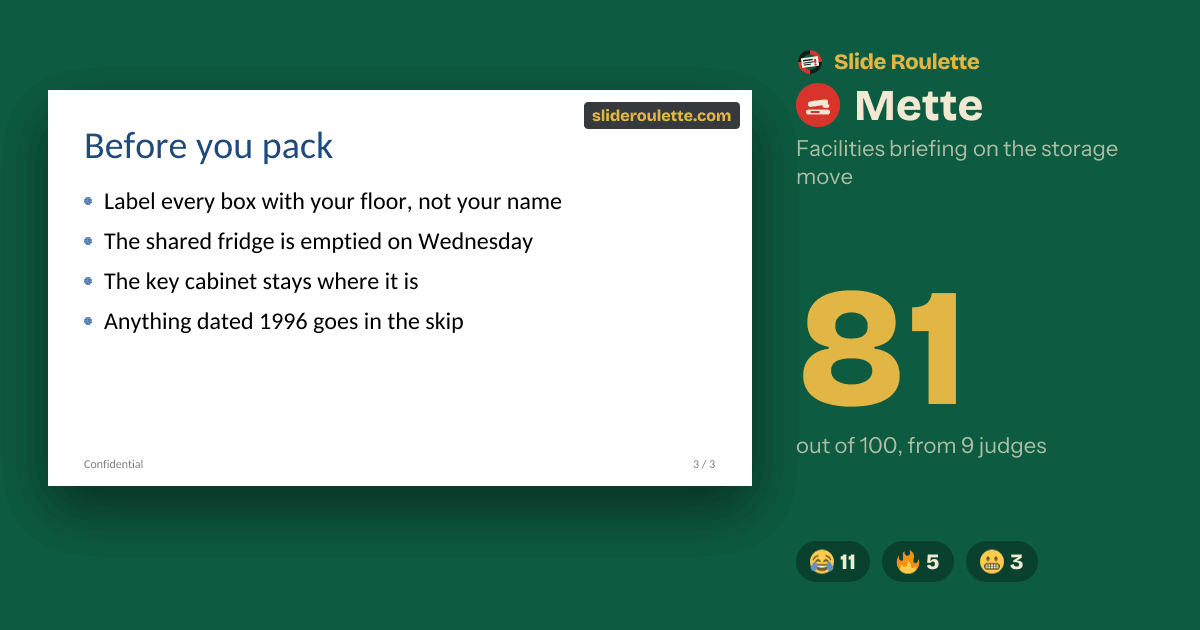
When a talk is scored, the room keeps the slide people reacted to most, with the score and the reactions. The presenter gets a link to share from their phone. That card is what ends up in the group chat.
Made for the julefrokost
Danish and English decks
Written in Danish, not translated. Office, party and absurd tones.
Safe mode for the office
Keeps the decks workplace-friendly when HR is in the room.
Any TV with a browser
The screen is a web page. Phones join over the same Wi-Fi or their own data.
Up to the whole company
Free for up to 8 players. A Party Pass takes the cap off for the evening.
Questions we get asked
- What do we need in the room?
- A television or a projector with a web browser, and a phone each. The big screen is a web page, so there is nothing to install and nobody who plays has to make an account.
- Does it work on the office guest Wi-Fi?
- Usually. The screen and the phones each talk to the internet rather than to each other, so they do not have to be on the same network at all: a phone on mobile data joins the same room as one on the guest network.
- How many can play, and what is free?
- Six is enough for there to be an audience, and thirty can still follow a round from the back table. Up to 8 players is free, and a Party Pass takes the cap off for the evening.
- Can we use our own presentations?
- Yes, with a Party Pass. Upload your own and the wheel deals them out beside the library, which is how a department ends up presenting its own quarterly review.
- Is it in Danish?
- Yes: the site, the room and the material. The Danish decks are written in Danish from the start rather than translated, and a round runs in the language the deck was written in.
- How long does an evening take?
- A round is four to six minutes with the voting. Three to five rounds is about half an hour, which is the length that leaves people wanting one more.
- Is it safe to run at work?
- Safe mode is on from the start, so the room only gets material you can put on a screen at the office. Turn it off when the evening has stopped being a work event.
Free to play. Paid to host well.
Free
$0
Classic and Lightning, up to 8 players, the everyday library.
Party Pass
$14.99 for 48 hours
Any number of players, Chaos and Tournament, the extra games, the seasonal decks and the decks you upload yourself.
Host Plus
$17.99 a month
Everything in the Party Pass, always, for the person who always hosts.